
Introduction
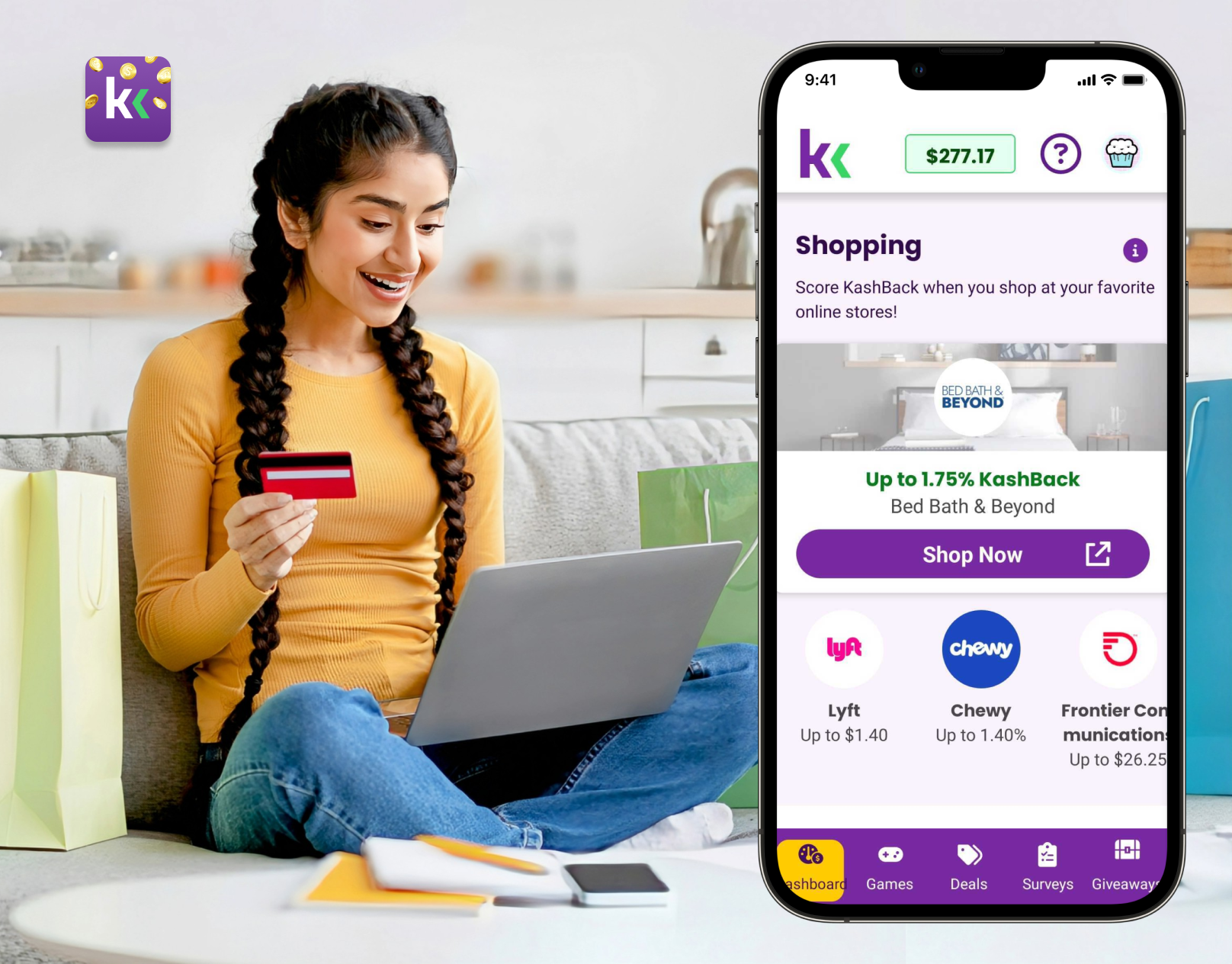
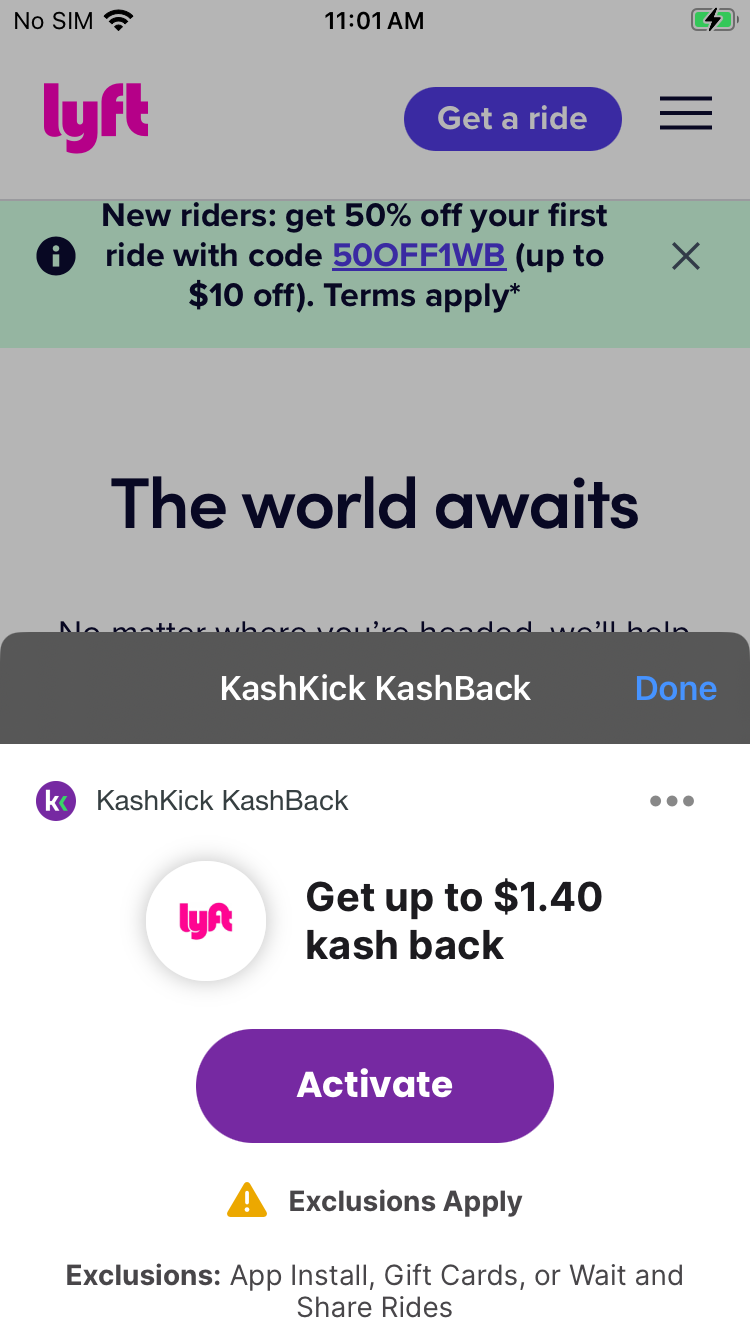
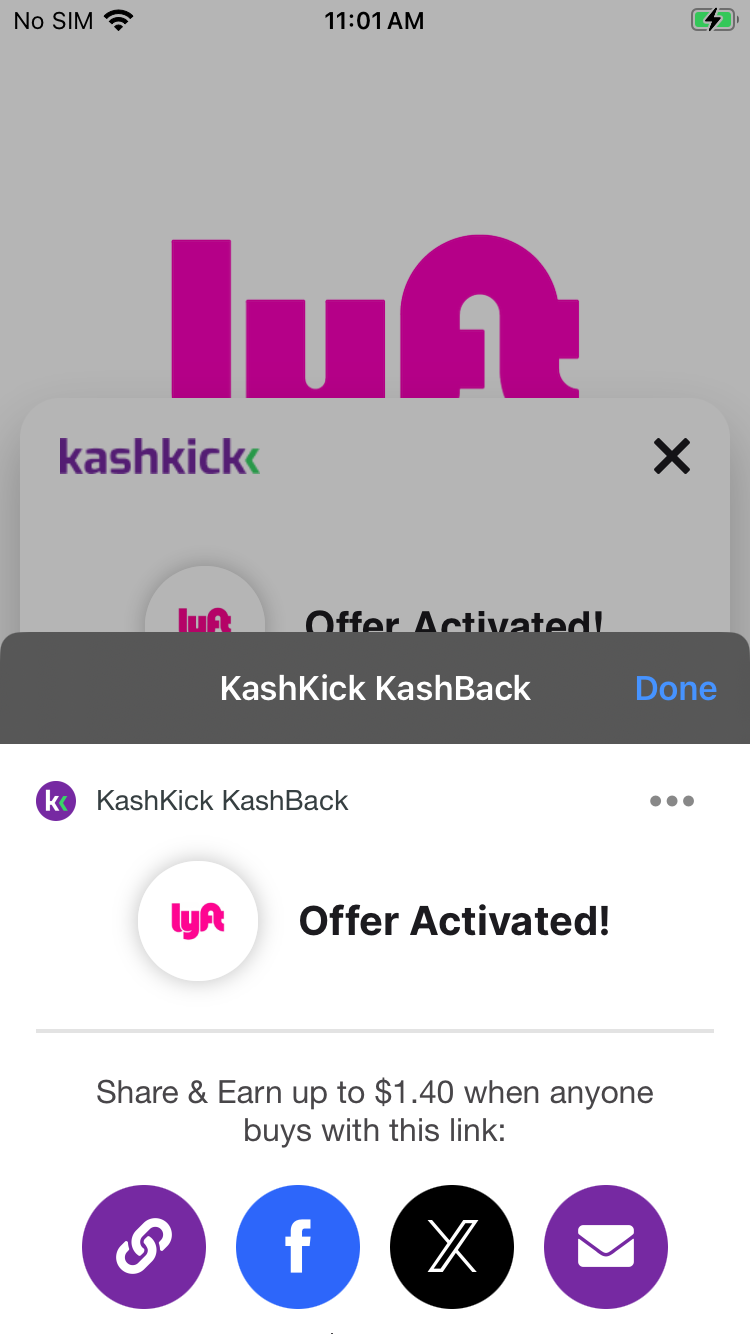
KashKick partnered with Wildfire to introduce shopping-based loyalty rewards, enabling users to earn cash back from everyday purchases. This initiative expanded KashKick’s earning ecosystem beyond games and required close coordination across product, engineering, marketing, and a third-party vendor to support a scalable rollout.
This case study highlights how structured rollout planning, system design, and launch processes transformed a complex vendor integration into a high-adoption revenue channel across mobile apps and browser extensions.

Shopping rewards experience introduced through third-party integration
Role & Scope
This work was led from a product strategy and integration facilitation perspective, in close partnership with Product, Engineering, Marketing, Data, Account Management, and the Wildfire vendor team.
The scope focused on:
Establishing rollout structure for a third-party loyalty rewards integration
Defining system logic and edge cases across mobile apps and browser extensions
Introducing UAT processes to reduce launch risk and vendor friction
Supporting feature promotion and user education to drive adoption
Business Context & Constraints
KashKick’s revenue model was historically driven by third-party game offers, with limited diversification across other earning categories. Introducing shopping-based rewards through a third-party vendor represented a new surface area for revenue, but also introduced operational and technical complexity.
The Wildfire integration needed to launch without disrupting existing systems, while working within vendor constraints, multiple platforms, and limited internal rollout processes. Any solution had to support scalability, reduce launch risk, and drive adoption without adding ongoing operational overhead.
Operational & System Complexity
Introducing Wildfire required more than a UI integration. The shopping rewards system touched nearly every part of the KashKick platform, spanning mobile apps, browser extensions, backend services, analytics, support, and marketing systems.
The initial Mobile Safari Extension (MSE) launch alone impacted:
iOS Dashboard and Deals surfaces
A new onboarding and instructional flow
Backend APIs connecting Wildfire, analytics, and internal systems
Offer configuration and admin tooling
Support workflows and help documentation
Event tracking for rewards, purchases, and commission states
Because Wildfire commissions move through multiple reward states (pending, ready, paid, canceled), the integration required careful coordination to ensure data consistency, user-facing clarity, and internal reconciliation across systems.
At the time of launch, KashKick did not yet have standardized processes for third-party rollouts, formal UAT, or cross-functional release coordination. This made risk management, testing coverage, and launch readiness critical to the success of the initiative.
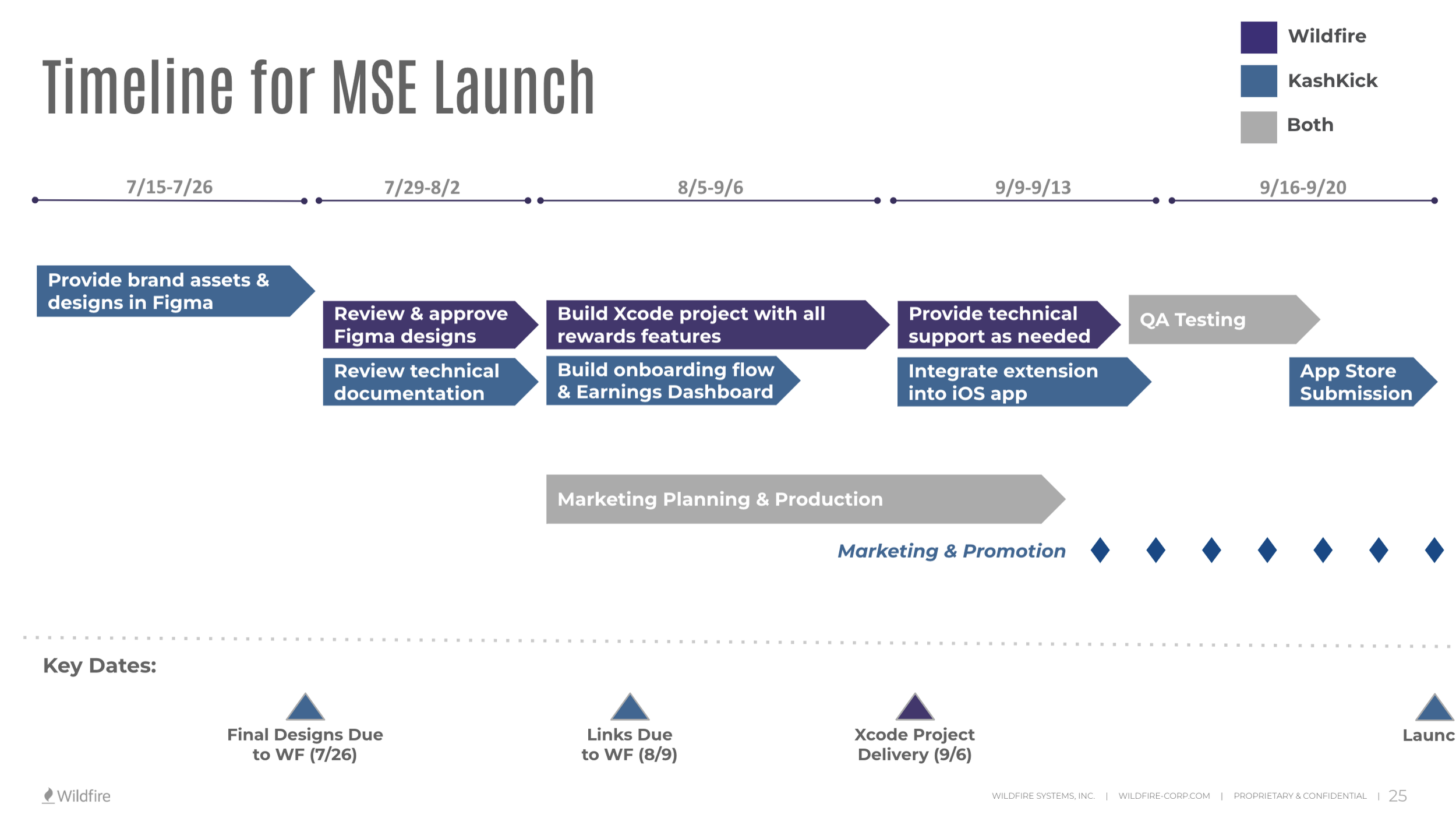
Wildfire MSE launch timeline: cross-team rollout & execution
Critical Activation Risk: Safari Permissions Flow
During MSE launch planning, we identified a high-risk activation dependency: Safari’s buried extension permissions flow required users to manually enable the extension and grant “Always Allow” access for tracking to function. Because incomplete setup would break attribution and impact revenue, we designed a guided, step-by-step onboarding flow aligned to Apple’s system UI to reduce confusion and increase enablement accuracy within a platform-controlled environment.
iOS Safari Extension Activation Flow & Risk Mitigation
The final activation flow combined incentive framing with a guided, step-indexed enablement experience aligned to Safari’s system UI. The experience ensured users completed all required permissions, reducing incomplete setup risk during MSE rollout.
Result: Enabled accurate tracking for MSE launch and reduced setup confusion within a platform-controlled environment.
Shipped Activation Experience
Rollout Strategy
Given the scale and complexity of the Wildfire integration, the rollout strategy prioritized risk reduction, cross-functional alignment, and adoption readiness rather than a single launch event.
The approach focused on introducing structure where none previously existed for third-party vendor launches, ensuring the integration could scale across platforms without creating operational drag.
Key components of the rollout strategy included:
Phased delivery
Launching the Mobile Safari Extension (MSE) first, followed by API-based mobile app support and later Chrome and Edge browser extensions, allowed the team to validate assumptions, stabilize systems, and iterate before expanding surface area.
Defined ownership across teams
Clear handoffs were established between Product, Engineering, Marketing, Support, and the vendor to avoid ambiguity around responsibilities, timelines, and dependencies.
Formalized UAT and validation flows
End-to-end testing scenarios were documented to cover onboarding, reward tracking, commission states, edge cases, and failure conditions; reducing post-launch issues and support burden.
Launch readiness and enablement
Instructional content, in-app education, and support documentation were developed alongside the feature to ensure users understood how shopping rewards worked and how earnings progressed.
Post-launch monitoring and iteration
Adoption, reward activity, and commission behavior were closely monitored to inform refinements and guide subsequent expansion to additional platforms.
This structured rollout transformed a complex vendor integration into a repeatable launch framework, enabling Wildfire to become a stable, high-adoption revenue channel rather than a one-off feature release.
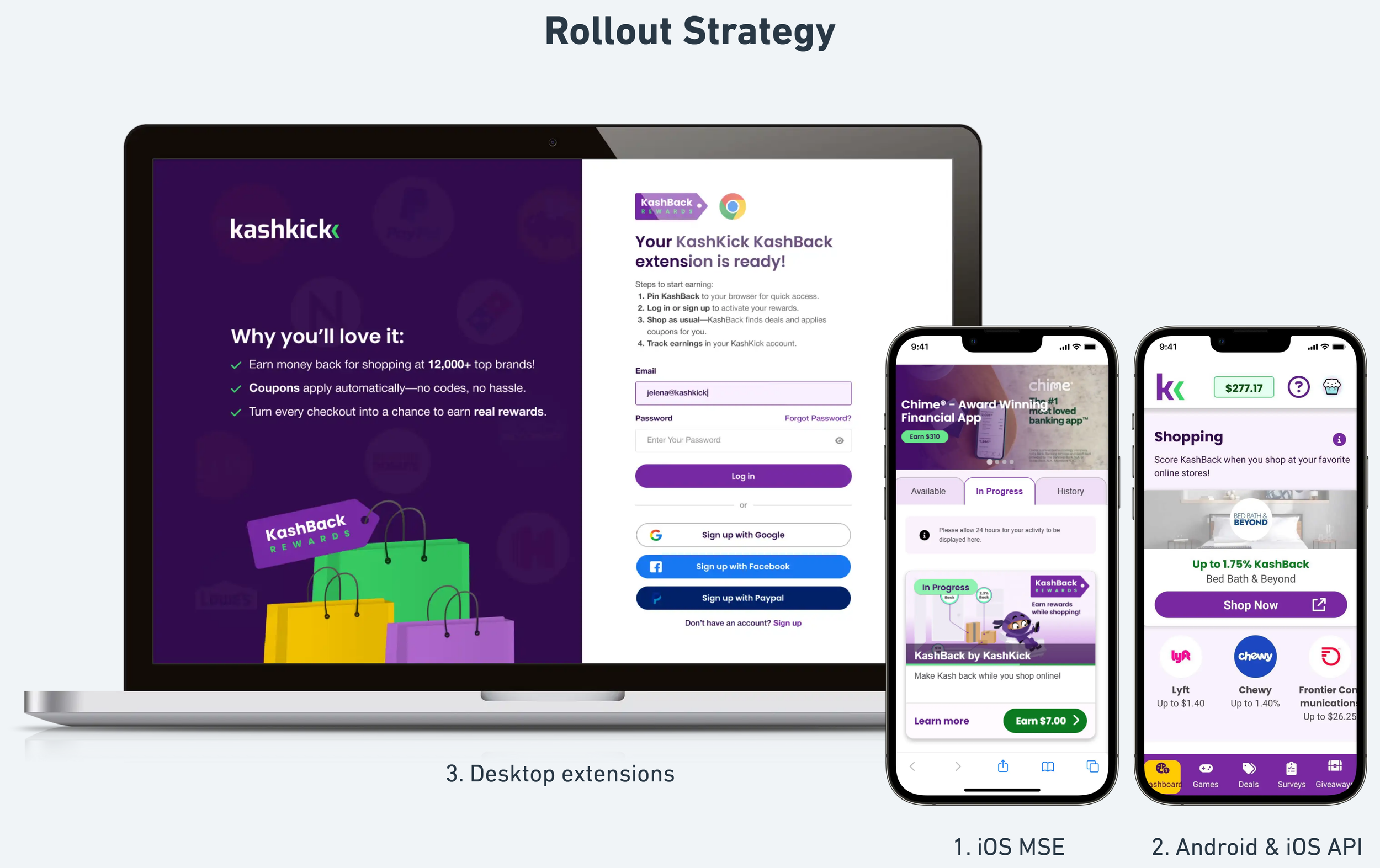
Phased rollout of shopping rewards across mobile and desktop
Execution & Launch Readiness
Launching Wildfire across mobile apps and desktop extensions required stronger operational structure than prior third-party integrations.
Clear rollout planning, platform-specific requirements, and a formal UAT process were introduced to align internal teams and the vendor around a shared launch plan. Logic flows and documentation reduced ambiguity across product, engineering, marketing, and Wildfire, helping surface issues earlier and avoid late-stage rework.
This approach enabled a smoother multi-platform launch and created a repeatable foundation for future third-party integrations.
Cross-platform logic flows & edge-case mapping
Impact & Results
The Wildfire integration expanded KashKick’s earning ecosystem beyond games, introducing shopping as a scalable, recurring revenue stream.
Following launch, shopping rewards demonstrated strong adoption relative to other third-party vendor integrations, particularly given the added complexity of supporting mobile apps, APIs, and browser extensions.
Key outcomes included:
Strong adoption compared to other Wildfire partner launches, establishing KashKick as a reference integration
Meaningful contribution to platform revenue, complementing existing deals and survey-based earnings
Successful expansion from an initial iOS implementation to a multi-platform system (mobile apps, Chrome, and Edge)
Improved lifecycle monetization, enabling users to earn through everyday purchases alongside games, deals, and surveys
Shopping rewards live across the KashKick app experience
Revenue outcomes from third-party shopping integration
Outcomes, Adoption, & Organizational Impact
The Wildfire launch surfaced gaps in KashKick’s existing third-party integration process, including the absence of formal rollout planning, cross-functional alignment, and coordinated feature promotion.
To support a multi-platform launch, a structured execution model was introduced that aligned Product, Engineering, Experimentation, Account Management, Data, Marketing, and the vendor around a shared plan. Clear ownership, documented logic flows, and a formal UAT process reduced ambiguity, surfaced issues earlier, and minimized late-stage rework.
Coordinated feature promotion and marketing collaboration ensured the shopping experience was visible, understood, and discoverable across platforms — a key driver of sustained adoption beyond initial install behavior.
This approach established a repeatable playbook for future vendor integrations, improving launch predictability, reducing operational overhead, and raising the bar for third-party execution.